|
This site dates from spring 2018, the last time this course was offered
It will next be offered in spring 2019
Current
Week 14
posted May 2:
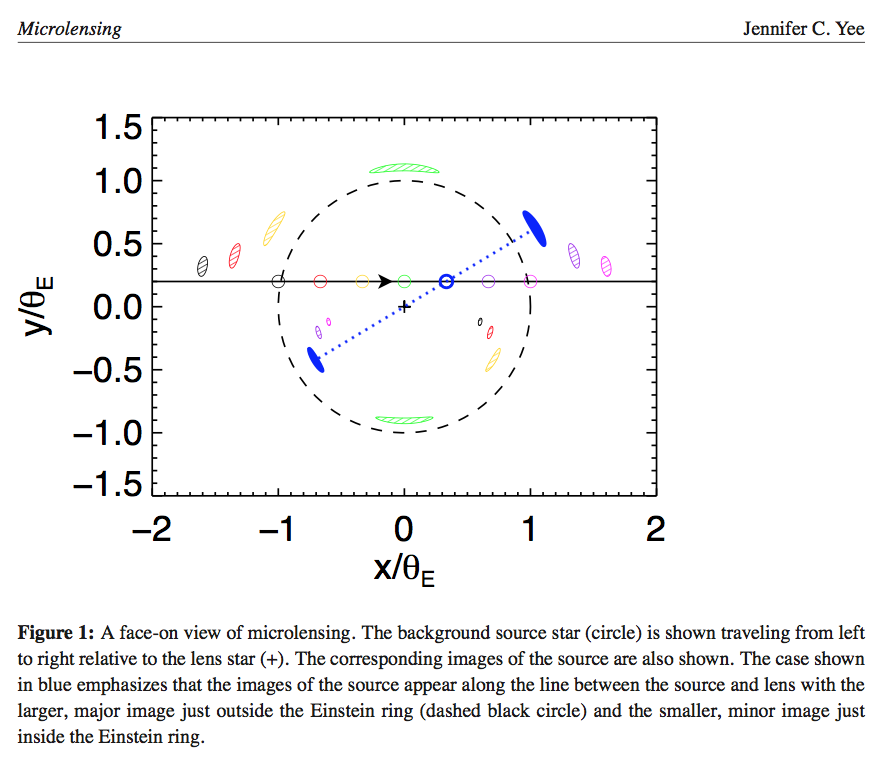
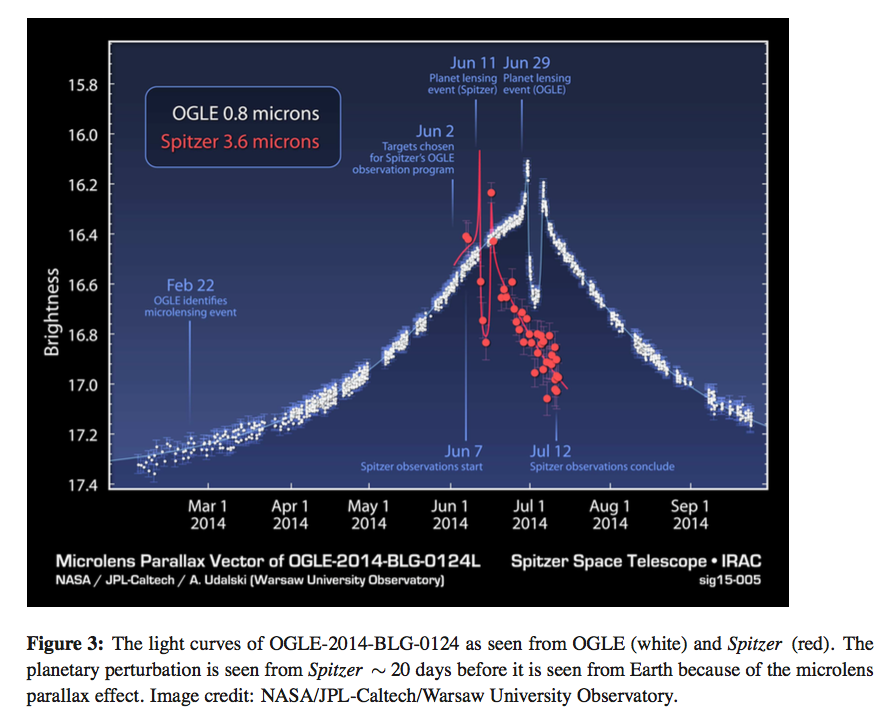
Cole has chosen "Microlensing: Exploring the Dark Corners of the Galaxy with a Thousand Tiny Flashlights," Yee, Bash Symposium, 2015.
Post at least one question on the new Moodle forum by Thursday at 10 pm. And please read each other's questions – and answer them if you want.
weekly archive of papers | schedule
Note that you can look up all sorts of things – including links to discovery papers – about all known exoplanets on exoplanets.org.
Topic
Our topic this semester is exoplanets. The study of exoplanets is of course one very important ingredient in our quest to understand the nature of life in the universe and to answer the question of whether we are alone. We are now more than 20 years into the era of exoplanet discovery, and what was once a new subfield focused on surprising discoveries has matured into one in which new scientific understanding is being produced at a rapid rate: understanding about the distribution of exoplanet properties (and by extension, about the possible formation and evolutionary histories of planetary systems), about the atmospheres of exoplanets and their interactions with their host stars, about planetary migration, and about new and future techniques for discovering and characterizing exoplanets. 2018 is an excellent time to survey the field and find out what's been learned, about new mysteries that have been uncovered, and what astronomers will try to learn in the near future.
Intro
The goals of this class include learning how to search and use the astronomical literature, to read papers critically, to apply your knowledge of physics and astronomy to research problems of current interest, and to learn about new developments in astrophysics. And also to learn about how the culture and production of science works – at least in astronomy.
Each week we will read a paper and meet for an hour to discuss it. We will take turns choosing the paper. The person who chooses the week's paper will write a short summary, to be sent out the night before our meeting, and will also introduce the paper at the beginning of class. Everyone else will come up with a question about something that puzzled you about the paper, or about something that you found interesting. You must post your question to Moodle's discussion board by 9PM on Thursday.
What is a paper? A research paper is an article that contains words and often some combination of numbers, equations, graphs, and images (and more recently, on-line supplements that include things like movies of numerical simulations). It usually reports on observations (or occasionally experiments) and/or calculations that address some problem or topic of interest to researchers in a particular subfield. To qualify as a research paper, it must advance the state of knowledge in the field in some important way. There are also review papers which summarize previous results and advances.
For research papers to be taken seriously, they must appear in a refereed journal. That is, they must pass peer review. Reviewers (anonymous "referees") are other scientists in the field (I write research papers and I also referee other people's papers; I usually know to one extent or another most of the authors of the papers I referee). The referee of a paper is charged with assessing the significance of the result described in the paper and with assessing whether the conclusions of the paper really do follow from the data and calculations presented.
There are four major journals in international astronomy, two American ones, The Astrophysical Journal and The Astronomical Journal, a British one, Monthly Notices of the Royal Astronomical Society, and a European one, Astronomy & Astrophysics. There are lower-profile journals, but the gap between them and the four major ones is (perceived to be) large. There are many useful and interesting publications that are unrefereed. Primary among these are conference proceedings papers. Aside from publishing research papers, giving talks at conferences - often quite specialized - is the main way scientists disseminate their research results. Most conferences publish a book, referred to as the conference proceedings, with a paper written by each speaker. Usually these papers follow very closely the talk itself. Importantly for readers like us, these conference proceedings papers fall into two often useful categories: the aforementioned review papers and papers that present preliminary results. Often the substance of a conference paper will appear in a refereed journal a few years later. So conference papers, if they're recent, can be a good way to see what new results might be coming soon. And even if they've been superseded by a refereed journal paper, they can still be shorter, more straightforward, and easier to read.
We should primarily read refereed papers and review articles from conference proceedings. But we shouldn't preclude ourselves from reading conference papers on new research.
I hope that by the end of the semester, you'll be scanning the literature on your own, on a regular basis...just like the pros do. But where to start? Note that there are several different types of places you might look for a paper, including the old fashion way: browsing paper copies on the library shelf (actually, our subscriptions to the major journals are on-line only now, to save money and space). You can find papers directly from the journals' websites (see links two paragraphs up). For the past 20 years or so, literature searches in astronomy have generally started on-line, with Astrophysics Data System (ADS) (non-profit, run out of Harvard/Smithsonian Astrophysical Observatory, with funding from NASA).
ADS catalogs papers from many (nearly every) journal currently published, and many old ones, too. It indexes many conference proceedings articles. From an ADS query you can see the title and author list and almost always an abstract, or paragraph-long description/synopsis of the paper. You can very often download the article in question (as well as see a list of citations, easily see other papers by the same authors, etc). Please realize that the availability of articles, especially recent ones, is often the result of a subscription Cornell Library has to the journal (costs can range from several $100 to several $1000 per year per journal). If you access articles via ADS (or otherwise) from off-campus, you might find your access restricted. You can always use the library's proxy server.
From the ADS query screen you can search for articles by a given author (that's how I use it most often, but I'm very familiar with who writes about what in my field). You can search for a key word in the title or in the abstract, for example. Go ahead and see what you find when you search for "massive stars" in the "title" field (or try the "abstract" field). You can search for articles that discuss particular objects. One of the more extreme and interesting massive stars is eta Carina. What papers can you find about this object (or some other, favorite massive star of yours)?. Note that you can restrict your search results based on publication year, by the type of article (refereed journal vs. conference proceedings paper, for example), sort your results by citation count, or any number of other parameters.
The only other database of papers that a professional astronomer is likely to consult regularly is astro-ph (part of arXiv) where scientists (and others, but not too many others) post papers, short articles, research notes, even lecture notes, ruminations, and direct responses to articles. This is great in a pure availability sense, but there's very little overt quality control (though the overall quality is remarkably high; note that the "comments" field associated with each article provides an opportunity for the author to indicate if the paper will appear in a refereed journal, and what stage of that process the paper is in). The vast majority of papers published in the main journals are posted by their authors to astro-ph. And they appear months ahead of time, quite often. Articles posted on astro-ph are freely available.
There are services that will sort papers on arXiv (like arxivsorter). I get a daily email with 24 hours worth of titles and abstracts. I get it unsorted because I like serendipitous discovery.
Functionally, for me anyway, its timeliness is the main utility of astro-ph. Also, some articles you find listed in ADS but without any actual article availability (they are published in obscure journals or conference proceedings) are posted by their authors to astro-ph. However, a few years ago, ADS started listing every article on astro-ph on its own database, so ADS really is the one-stop shopping article database for astronomers. Just make sure you have the "arXiv e-prints" box near the top of the query page checked.
Another mode of finding articles is the "newsletter." Many subfields in astronomy have newsletters, to which people in the field submit articles. Most all of these will also appear on astro-ph, but the newsletter collects them in one place, undiluted by articles on other subjects. Sub-field specific newsletters often have additional items such as meeting announcements, job postings (for post-doctoral positions, working on a specific problem, usually), and even obituaries. Newsletters are getting to be a relic of another time, but they aren't yet – as they have a concentrated, unadulterated dose of one's chosen subfield. You might check out the Massive Star News and the Star Formation Newsletter.
Finally, you may want to find out about a particular object or search a catalog for information about an object (e.g. distance, spectral type, magnitude and colors). A good way to do this is via SIMBAD. Note that the entry for any object will provide a list of all the articles published since 1850 that mention that object.
Business
Each week, one of us will chose a paper for us all to read. We'll read it, and then the person who chose the paper will send a summary of it to the class by 9PM on Thursday. And each (other) student will post at least one question on the discussion board forum, also by 9PM on Thursday. The discussion board is available on the class Moodle page.
Whoever's turn it is to choose a paper for a given week should already have some ideas to share with David at the end of class the previous week. So, when it's your turn (schedule soon to be posted), start thinking about what paper you'd like to read about two weeks ahead of time.
David will choose the first paper of the semester, and then we'll establish a rotating schedule. Students will each sign up for a week in which they'll choose a paper to present.
Resources
Astrophysics Data System (ADS) query page, broad paper search by keyword, author, topic, etc. Complete for all major and relatively minor journals as well as many conference proceedings and other non-peer-reviewed articles.
arXiv's astro-ph listing a public preprint server (i.e. authors of papers can post their papers here, often before they are actually published). Over the last two decades, this has become the go-to place to find papers. But in practice, ADS links to all papers on astro-ph, so you can just start your search there, if you want.
Astrobites: a summary of select papers on astro-ph. It's written by graduate students, for undergraduates.
AAS Nova: Highlights from the journals of the American Astronomical Society (Ap.J. and AJ)
Annual Reviews of Astronomy and Astrophysics: prestigious invited and refereed review articles; they tend to be lengthy. We could read part of one article.
Encyclopedia of Astronomy and Astrophysics: few-page articles on specific topics, written at a pretty high level. Useful for finding information about something you read in a paper. And also potentially useful for reading more about a sub-topic, concept, or class of objects that you'd like to find a paper about.
SIMBAD database: you can look up any astronomical object's properties (and images of it) here.
exoplanets.org database: comprehensive database of known exoplanets, with information including bibliographic information, about each one. Also has a great customizable data plotter.
|